
Clinic conversations
Understand where journaling supports reflection—and where a blank page creates friction.
“Too much pressure”“Hard to begin”“Useful between sessions”
A quieter way
to journal.
An ongoing collaboration with a psychology clinic to shape a journaling app that helps people begin writing, understand recurring patterns and turn reflection into something useful.
Strategy · Identity · UX · UI · Art direction
The opportunity · Ongoing clinic collaboration
Working alongside a psychology clinic, the project is exploring how reflective practice can become easier to begin and more useful between sessions. Specific clinical material remains confidential.
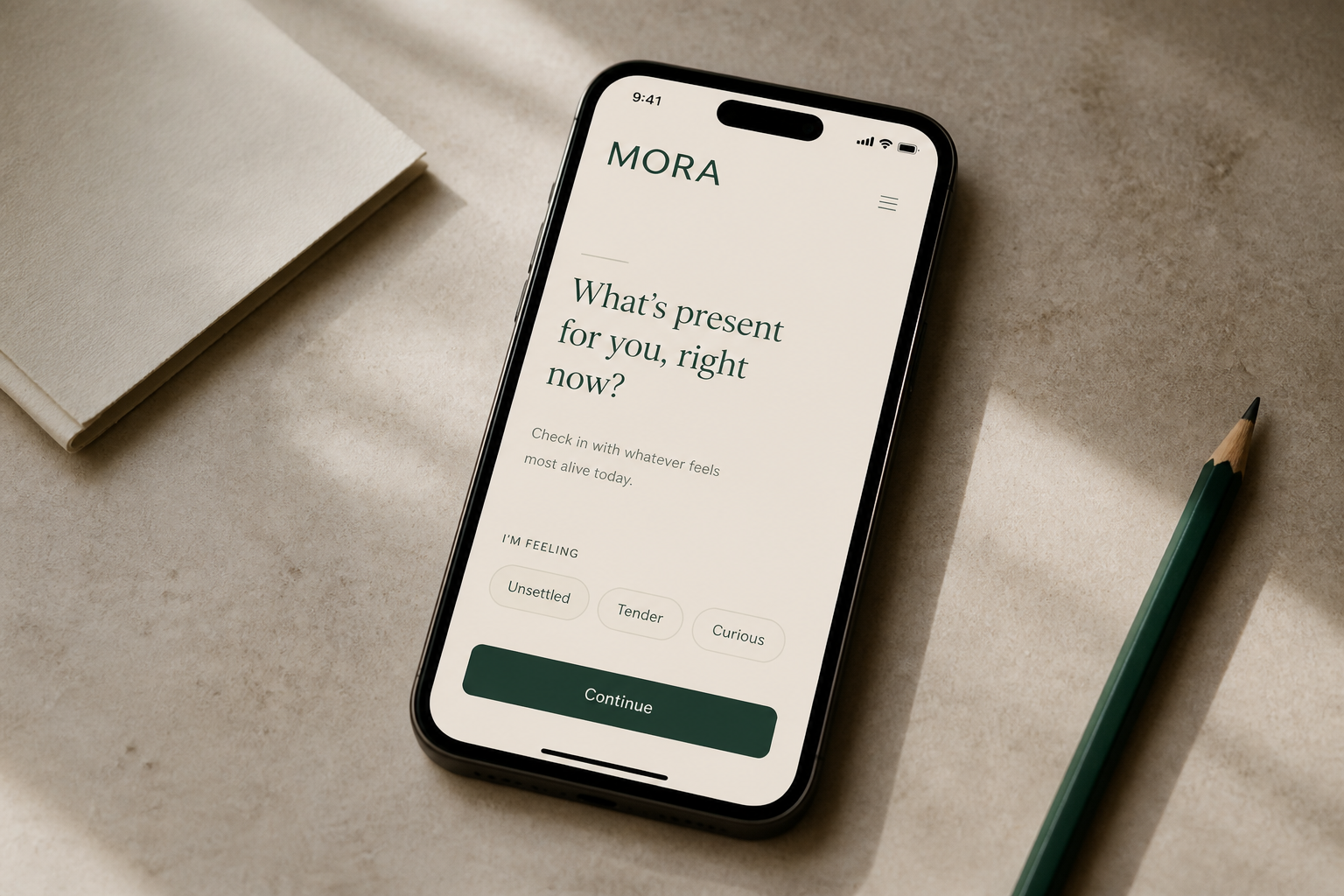
MORA begins with what is present now, asks one useful question at a time and gradually helps users recognise the themes already inside their writing.
01 · Identity
MORA’s identity balances clarity with reflection. The open counter inside the O becomes a pause, a journal entry and a window into something still forming.
#202925
#F3F0E8
#D9D4CA
#B7C96B
Ask, don’t instruct.
Reflect, don’t diagnose.
Make room, don’t rush.
02 · Experience
The four-part flow emerged through clinic conversations, behaviour mapping, prompt writing and low-pressure prototype testing—not from naming four screens first.
Understand where journaling supports reflection—and where a blank page creates friction.
Group needs into four moments: entering, exploring, recognising and looking back.
Replace advice with short, open questions that preserve the user’s authorship.
Ask one thing.
Leave room.
Never diagnose.
Test length, tone and stopping points; reduce the flow until it feels easy to leave.
The product rhythm shaped by those findings
Two words are enough.
A two-word check-in lowers the pressure to write something meaningful.
What made that feeling
a little louder?
One adaptive prompt helps the user move from an event to the feeling beneath it.
MORA quietly links recurring themes without diagnosing or labelling the person.
“I needed more time
before saying yes.”
A weekly reflection returns the user’s own words as a clear, editable picture.
03 · Product UI
A tactile, editorial interface makes the app feel closer to a private notebook than a clinical tracker.
“I kept saying yes when I wanted more time.”
“I needed more time before saying yes.”
04 · Why it is useful
MORA adds just enough structure to make journaling sustainable, while preserving the privacy and authorship that make it valuable.
Small prompts make journaling approachable on ordinary, difficult and uneventful days.
Themes such as energy, boundaries, confidence and belonging emerge across entries.
MORA reflects language back; it does not score emotions or turn a life into a dashboard.
Users can prepare for therapy, a conversation or a personal decision in their own words.
Product boundaries

Write to notice.
Reflect to understand.
05 · The difference it could make
People who begin the two-word check-in and complete a first private reflection.
A sustainable rhythm without streaks, penalties or pressure to write every day.
Users choosing to return because the reflection remains useful—not because of gamification.
Pilot participants reporting that MORA helped them prepare for a therapy session or important conversation.
SUCCESS IS NOT
SUCCESS IS
HUMANLower pressure at the moment someone wants to begin.
CLINICMore useful self-authored material between conversations.
RESPONSIBLE PRODUCTNo diagnosis, mood scoring or manipulative retention mechanics.
Illustrative pilot framework · Figures are product-design targets, not clinical claims or reported patient outcomes.
The proposition